
Starting Marriage Therapy early can help couples address communication problems, recurring conflicts, emotional distance, and unmet expectations before these issues become deeply established patterns. Early professional support can give partners practical relationship skills, improve understanding, strengthen emotional connection, and create healthier ways to handle future challenges. Couples therapy is not only for relationships in crisis; it can also help couples strengthen their bond and build a stronger foundation for preventing future conflicts.
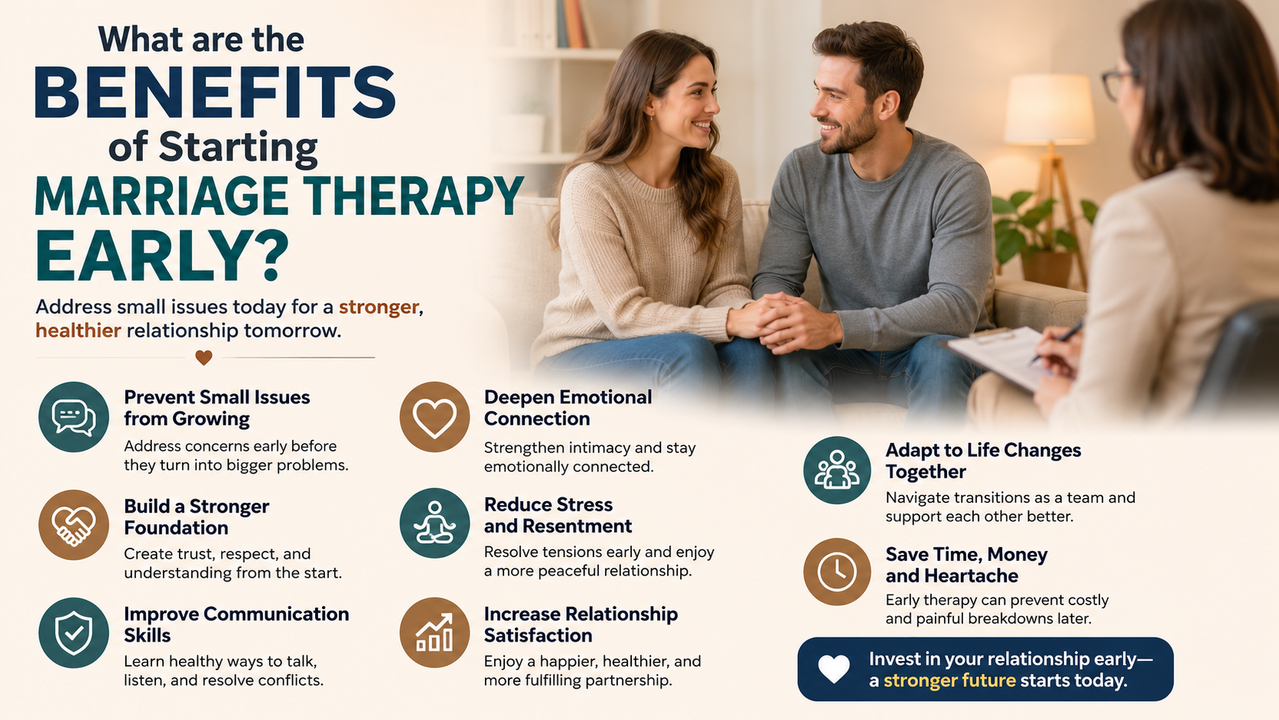
Many couples wait until relationship problems become severe before considering professional support. By that point, repeated arguments, resentment, avoidance, or emotional disconnection may have become familiar parts of everyday life. Seeking support earlier can provide an opportunity to recognize these patterns while they are still more manageable.
Seeking Therapy can be part of a proactive approach to relationship health, giving couples a structured setting where they can discuss concerns, develop communication skills, and work toward stronger relationship habits.
Why Is Early Marriage Therapy Important?
Relationship problems often develop gradually rather than appearing overnight.
A disagreement about finances may initially seem minor. A communication misunderstanding may happen occasionally. A difference in parenting preferences may seem manageable.
However, if these issues are repeatedly ignored, they can create frustration and resentment.
The American Psychological Association notes that couples do not have to wait until a relationship shows serious signs of trouble before working to strengthen it. Relationship education and skills such as communication, listening, and conflict management can help couples maintain healthier relationships.
Early therapy gives couples an opportunity to work on these areas before negative patterns become harder to change.
1. It Can Prevent Small Problems From Becoming Bigger
One of the clearest benefits of starting therapy early is the opportunity to address concerns while they are still relatively manageable.
A couple might notice that they are arguing more frequently, spending less meaningful time together, or struggling to communicate about a particular subject.
Instead of allowing these problems to continue for years, couples can seek professional guidance and learn how to approach them differently.
Early intervention does not guarantee that every relationship problem will disappear. However, it can give couples more opportunities to understand the issue and experiment with healthier solutions.
2. Couples Can Improve Communication Earlier
Communication problems can influence almost every part of a relationship.
When partners struggle to communicate effectively, disagreements about money, parenting, household responsibilities, intimacy, or family relationships can become more difficult.
Early therapy can help couples develop skills such as:
Learning these skills early can help couples use them when future challenges arise.
3. It Can Interrupt Repeating Conflict Cycles
Many couples experience recurring arguments that seem to follow the same script.
One person raises an issue. The other becomes defensive. The first partner becomes more frustrated. The second partner withdraws. Eventually, the conversation ends without solving anything.
The same pattern may happen again a few days or weeks later.
Marriage therapy can help couples identify these cycles.
Once partners understand the pattern, they can begin changing how they respond to each other.
Early intervention can be particularly useful because couples may have fewer years of entrenched interaction habits to overcome.
4. Couples Can Build Emotional Connection
Emotional connection can gradually weaken when partners become busy with work, children, household responsibilities, or other pressures.
A couple may still function effectively as a household while feeling increasingly disconnected as romantic partners.
Early therapy can encourage couples to pay attention to emotional connection before distance becomes severe.
Partners may explore:
5. It Can Help Couples Establish Healthy Relationship Habits
Healthy relationships require ongoing attention.
Couples can benefit from developing habits around communication, appreciation, conflict management, and emotional connection.
Starting therapy early can help partners learn these skills before unhealthy patterns dominate the relationship.
For example, couples may learn to have regular conversations about concerns rather than waiting until frustration reaches a breaking point.
They may also learn to recognize and appreciate positive behaviors instead of focusing exclusively on mistakes.
The goal is to make healthy relationship practices part of everyday life.
6. Couples Can Address Expectations Before They Cause Resentment
Partners do not always enter marriage with identical expectations.
They may have different ideas about:
Problems can arise when expectations remain unspoken or when partners assume their way of viewing marriage is automatically shared by the other person.
Early therapy can provide a structured environment for discussing these expectations.
Partners can identify differences and work toward practical agreements before those differences develop into ongoing resentment.
7. It Can Prepare Couples for Major Life Changes
Relationships often face periods of transition.
Having a child, changing careers, moving, retirement, financial changes, or children leaving home can alter a couple's routines and responsibilities.
Harvard Health notes that major life transitions can place strain on relationships and that couples therapy can help partners reconnect, redefine roles, and adapt to new stages of life.
Seeking support before or during a major transition can give couples an opportunity to discuss expectations and potential sources of stress.
Instead of waiting until a transition creates serious conflict, partners can proactively plan how they will support one another.
8. Couples May Become Better at Handling Stress Together
External stress does not automatically create relationship problems, but it can make existing weaknesses more noticeable.
Work pressure, financial concerns, parenting demands, and family responsibilities can leave partners with less emotional energy.
A couple that already struggles to communicate may find these difficulties intensify during stressful periods.
Early therapy can help partners learn how to recognize stress and respond to one another more constructively.
The objective is not to eliminate every stressful event. It is to help couples approach challenges as a team rather than turning against one another.
Final Thoughts
Starting marriage therapy early can help couples address relationship concerns before they become deeply established, while also giving partners practical tools for communication, conflict resolution, emotional connection, and adapting to major life changes. Therapy is not only for couples facing serious crises; it can also be a proactive way to strengthen a relationship and build healthier habits for the future.
Waiting until a relationship reaches a breaking point is not the only reason to seek professional support. Couples can seek help when they first notice recurring disagreements, emotional distance, communication problems, or uncertainty about how to handle a new stage of life. With the right professional guidance and active participation from both partners, early support can provide a stronger foundation for navigating future challenges. Seeking Therapy can be a resource for couples who want to understand their relationship more clearly and work toward healthier communication and connection.
Many couples wait until relationship problems become severe before considering professional support. By that point, repeated arguments, resentment, avoidance, or emotional disconnection may have become familiar parts of everyday life. Seeking support earlier can provide an opportunity to recognize these patterns while they are still more manageable.
Seeking Therapy can be part of a proactive approach to relationship health, giving couples a structured setting where they can discuss concerns, develop communication skills, and work toward stronger relationship habits.
Why Is Early Marriage Therapy Important?
Relationship problems often develop gradually rather than appearing overnight.
A disagreement about finances may initially seem minor. A communication misunderstanding may happen occasionally. A difference in parenting preferences may seem manageable.
However, if these issues are repeatedly ignored, they can create frustration and resentment.
The American Psychological Association notes that couples do not have to wait until a relationship shows serious signs of trouble before working to strengthen it. Relationship education and skills such as communication, listening, and conflict management can help couples maintain healthier relationships.
Early therapy gives couples an opportunity to work on these areas before negative patterns become harder to change.
1. It Can Prevent Small Problems From Becoming Bigger
One of the clearest benefits of starting therapy early is the opportunity to address concerns while they are still relatively manageable.
A couple might notice that they are arguing more frequently, spending less meaningful time together, or struggling to communicate about a particular subject.
Instead of allowing these problems to continue for years, couples can seek professional guidance and learn how to approach them differently.
Early intervention does not guarantee that every relationship problem will disappear. However, it can give couples more opportunities to understand the issue and experiment with healthier solutions.
2. Couples Can Improve Communication Earlier
Communication problems can influence almost every part of a relationship.
When partners struggle to communicate effectively, disagreements about money, parenting, household responsibilities, intimacy, or family relationships can become more difficult.
Early therapy can help couples develop skills such as:
- Listening without immediately becoming defensive
- Expressing needs clearly
- Asking questions instead of making assumptions
- Discussing difficult subjects respectfully
- Recognizing emotional triggers
- Taking breaks when conversations become overwhelming
- Returning to important conversations after cooling down
Learning these skills early can help couples use them when future challenges arise.
3. It Can Interrupt Repeating Conflict Cycles
Many couples experience recurring arguments that seem to follow the same script.
One person raises an issue. The other becomes defensive. The first partner becomes more frustrated. The second partner withdraws. Eventually, the conversation ends without solving anything.
The same pattern may happen again a few days or weeks later.
Marriage therapy can help couples identify these cycles.
Once partners understand the pattern, they can begin changing how they respond to each other.
Early intervention can be particularly useful because couples may have fewer years of entrenched interaction habits to overcome.
4. Couples Can Build Emotional Connection
Emotional connection can gradually weaken when partners become busy with work, children, household responsibilities, or other pressures.
A couple may still function effectively as a household while feeling increasingly disconnected as romantic partners.
Early therapy can encourage couples to pay attention to emotional connection before distance becomes severe.
Partners may explore:
- What makes each person feel valued
- How they express affection
- What makes them feel emotionally supported
- Which experiences have created distance
- How they can create more meaningful time together
5. It Can Help Couples Establish Healthy Relationship Habits
Healthy relationships require ongoing attention.
Couples can benefit from developing habits around communication, appreciation, conflict management, and emotional connection.
Starting therapy early can help partners learn these skills before unhealthy patterns dominate the relationship.
For example, couples may learn to have regular conversations about concerns rather than waiting until frustration reaches a breaking point.
They may also learn to recognize and appreciate positive behaviors instead of focusing exclusively on mistakes.
The goal is to make healthy relationship practices part of everyday life.
6. Couples Can Address Expectations Before They Cause Resentment
Partners do not always enter marriage with identical expectations.
They may have different ideas about:
- Household responsibilities
- Money
- Parenting
- Career priorities
- Intimacy
- Family boundaries
- Time together
- Personal independence
- Long-term goals
Problems can arise when expectations remain unspoken or when partners assume their way of viewing marriage is automatically shared by the other person.
Early therapy can provide a structured environment for discussing these expectations.
Partners can identify differences and work toward practical agreements before those differences develop into ongoing resentment.
7. It Can Prepare Couples for Major Life Changes
Relationships often face periods of transition.
Having a child, changing careers, moving, retirement, financial changes, or children leaving home can alter a couple's routines and responsibilities.
Harvard Health notes that major life transitions can place strain on relationships and that couples therapy can help partners reconnect, redefine roles, and adapt to new stages of life.
Seeking support before or during a major transition can give couples an opportunity to discuss expectations and potential sources of stress.
Instead of waiting until a transition creates serious conflict, partners can proactively plan how they will support one another.
8. Couples May Become Better at Handling Stress Together
External stress does not automatically create relationship problems, but it can make existing weaknesses more noticeable.
Work pressure, financial concerns, parenting demands, and family responsibilities can leave partners with less emotional energy.
A couple that already struggles to communicate may find these difficulties intensify during stressful periods.
Early therapy can help partners learn how to recognize stress and respond to one another more constructively.
The objective is not to eliminate every stressful event. It is to help couples approach challenges as a team rather than turning against one another.
Final Thoughts
Starting marriage therapy early can help couples address relationship concerns before they become deeply established, while also giving partners practical tools for communication, conflict resolution, emotional connection, and adapting to major life changes. Therapy is not only for couples facing serious crises; it can also be a proactive way to strengthen a relationship and build healthier habits for the future.
Waiting until a relationship reaches a breaking point is not the only reason to seek professional support. Couples can seek help when they first notice recurring disagreements, emotional distance, communication problems, or uncertainty about how to handle a new stage of life. With the right professional guidance and active participation from both partners, early support can provide a stronger foundation for navigating future challenges. Seeking Therapy can be a resource for couples who want to understand their relationship more clearly and work toward healthier communication and connection.